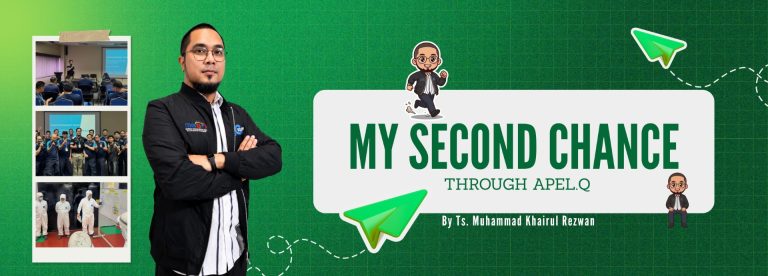
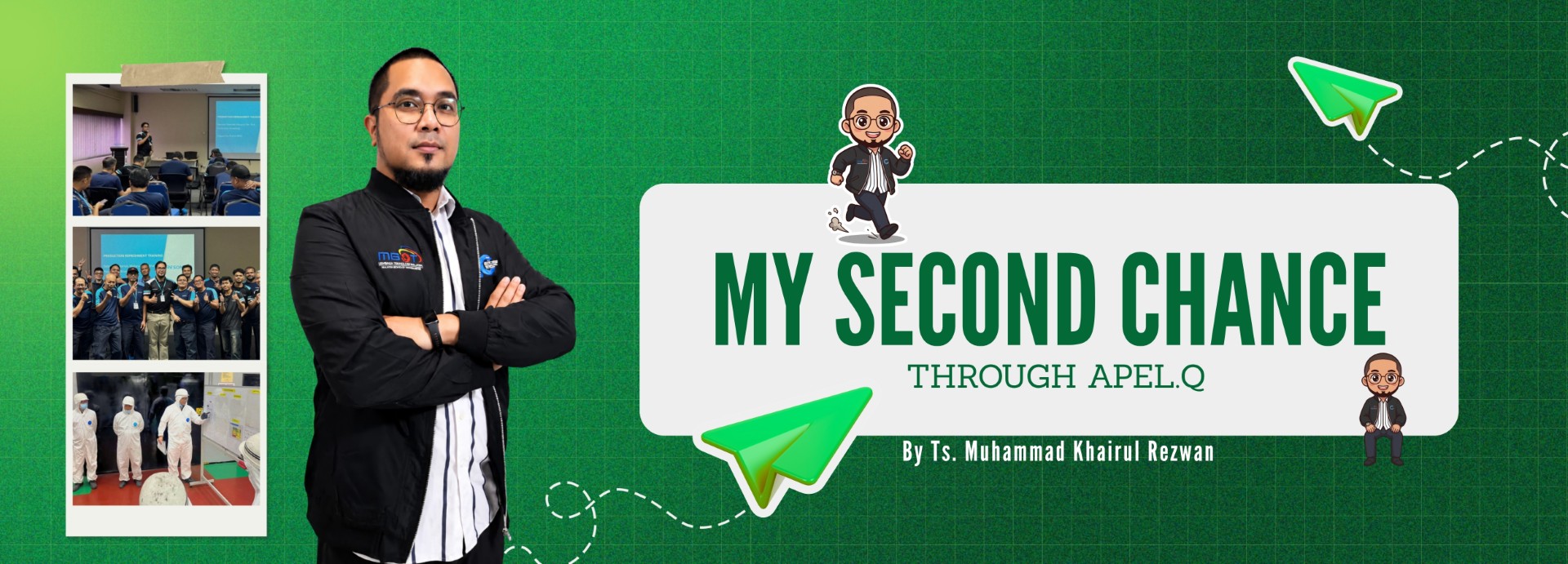
By Ts. Muhammad Khairul Rezwan
My journey through Accreditation of Prior Experiential Learning for Qualification (APEL.Q) has become one of the most meaningful turning points in my life and career. As an adult learner from the manufacturing sector, I spent years developing knowledge, skills, and confidence through production operations, engineering support, quality control, Lean Six Sigma, SAP usage, manpower coordination, and improvement projects.
Before APEL.Q, this experience remained informal because it was not recognised academically.
After reading the literature review on recognition of prior learning, I began to understand my own journey more deeply. As mentioned by Raciti (2024), recognition of prior learning is important because it allows knowledge gained through work, life, and informal learning to be valued within higher education. This reflects my experience. For many industrial workers, learning happens every day through problem-solving, decision-making, teamwork, and workplace responsibility. However, without evidence and academic assessment, this learning is often invisible.
Guided by MQA (2020) Guideline on APEL.Q, I realised that APEL.Q is not simply a shortcut to obtain a degree. It is a structured academic assessment process that requires candidates to prove that their prior experiential learning is equivalent to formal programme learning outcomes. This changed the way I viewed my experience.
I began to see appointment letters, training records, certificates, project reports, technical documents, work emails, improvement projects, and workplace achievements not merely as personal records, but as evidence of learning, competency, and development.
The most challenging part of my APEL.Q journey was translating practical experience into academic language. Tasks that I previously considered normal workplace responsibilities, such as planning manpower, solving production issues, improving quality, coordinating departments, and supporting management decisions, had to be explained as evidence of learning and achievement. This process helped me reflect on my development as an industrial worker and adult learner.
It also made me realise that experience becomes more valuable when documented and connected to academic standards.
One of my proudest achievements was obtaining a Bachelor’s Degree in Manufacturing Management through APEL.Q. My capstone project focused on Lean Six Sigma and SAP integration, which was closely related to my experience in manufacturing operations, quality improvement, and productivity. After completing APEL.Q, my confidence increased, and my professional identity became stronger. I later obtained Professional Technologist recognition through MBOT.
APEL.Q also opened opportunities in academia, research, and innovation.
I am currently pursuing PhD in Management at UniKL through first-class degree fast-track admission, focusing on APEL.Q graduates’ managerial roles, lifelong learning, and career development among adult working learners. I have also become a UiTM co-supervisor for a bachelor’s degree final-year project to develop the MyPortfolio mobile app prototype. At the same time, I am applying for a DPIM Applied Research grant as a MARA Research Assistant (Project Lead Support) to develop MyPortfolio into a web-based platform.
For me, APEL.Q is a second chance that proves education does not happen through one pathway only. Work experience, when guided by evidence, reflection, and proper assessment, can become a source of academic recognition and career development.