




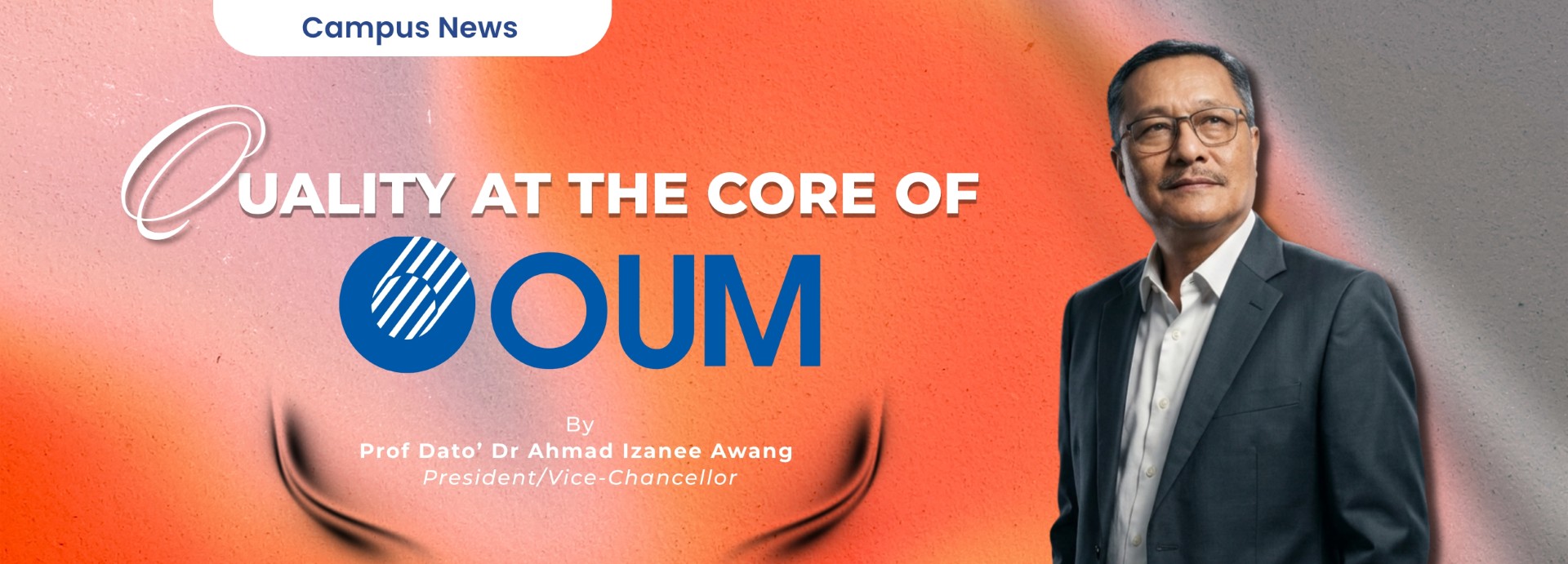
By Prof Dato’ Dr Ahmad Izanee Awang, President/Vice-Chancellor
What are the things you look for in an academic programme? For many people, accreditation status is probably high on that list. After all, accreditation serves as a seal of approval, confirming that a programme has met established standards and that its qualification is recognised.
However, accreditation alone does not equate to institutional quality. Rather, it is one tangible outcome of a university’s broader commitment to quality. At OUM, this commitment involves upholding high academic standards, complying with regulatory frameworks, continuously improving the quality of our services, and perhaps most importantly, nurturing a culture of quality across the University.
For me personally, putting quality first means doing things the right way, even when no one is looking. Quality does not happen by accident; it must be intentionally designed and sustained. Much of this responsibility falls to the Centre for Quality Assurance (CQA), OUM’s dedicated unit responsible for quality assurance and management across the University.
Much of CQA’s work happens behind the scenes. Through internal audits and monitoring, capacity building, documentation and reporting, as well as policy development and implementation, the Centre serves as OUM’s guardian of both academic and operational quality. By ensuring that standards and regulatory requirements are met, that the appropriate safeguards are in place, and that best practices are identified and adopted for continuous improvement, CQA plays an important role in protecting OUM’s reputation as a credible and quality-assured institution.
That said, quality is not CQA’s responsibility alone, it is everyone’s. Across OUM, different teams are keeping a close watch on emerging trends that shape how we approach quality management. Through digital transformation, for instance, we are exploring how AI and other technologies can help us move beyond traditional document-heavy processes toward more data-driven decision-making.
Through stronger university-industry collaboration, we are identifying academic-industry benchmarks that can enhance curricular relevance and graduate employability. And through a growing focus on sustainability, we are examining ethical and responsible work practices that align with environmental, social, and governance (ESG) principles.
These are by no means simple undertakings, but they are necessary if we are to sustain our identity as a university that champions quality. Beyond meeting external regulatory requirements, quality must be embraced as a way of life, one in which every member of the OUM community shares a mindset of continuous improvement across all aspects of university operations.
Ultimately, quality is not just about meeting standards, it is about constantly striving to exceed them.